
L o s t
Global description
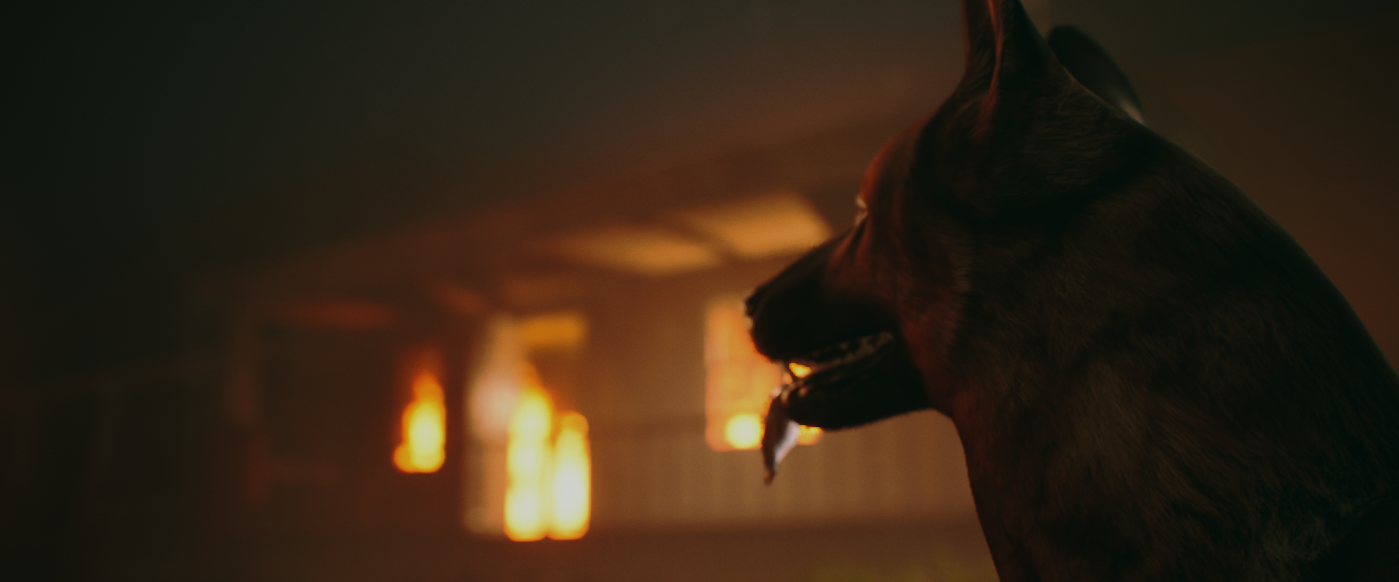
Lost is a 5 to 10 minute demo in which the player takes control of a dog at the beginning of a zombie apocalypse.
The main goal of the project was to work on the game environment while developing a realistic and intuitive locomotion system for the dog, in order to enhance immersion, improve the credibility of movement, and provide an enjoyable gameplay experience.
This project was entirely developed by me using Unreal Engine.
Dog locomotion mechanics
In the game, the player can take control of a dog. I therefore had to develop a canine character with natural and enjoyable locomotion.
To achieve this, after implementing a simple movement system, I used the Motion Matching tool in Unreal Engine.
The system is based on recording a large number of animations (running, stopping, turning, accelerating, etc.). Each frame is then enriched with metadata (“tagged”) such as speed, direction, body posture, and foot placement.
The engine then analyzes the character’s current situation: it takes into account where the character wants to move, its current speed, and its orientation. Based on this information, it searches in real time for the most suitable pose within the animation database.
It selects the best “match” and continuously updates this choice every frame. This process results in smooth, natural movement without visible transitions.
Dog improvement
To enhance the realism of the dog’s movement, I implemented an Inverse Kinematics (IK) system for all four legs.
In traditional animation, joints are controlled in a hierarchical order, from top to bottom: hip → knee → ankle → foot. However, with IK, the process is reversed: the foot is positioned first (for example, placed on the ground), and the system automatically calculates how the rest of the leg should bend to reach that position naturally.
I applied this system to each of the dog’s limbs to ensure proper ground contact. This allows the paws to realistically adapt to uneven terrain, improving immersion and avoiding visual issues such as foot sliding or floating above the ground.
To go a bit further technically, the IK system I used works by solving joint positions in real time based on target constraints. It also includes parameters such as bone chain length and joint limits to preserve anatomical plausibility. In some cases, a simple foot trace or raycast is used to detect the ground height, ensuring that each paw correctly aligns with the surface.
Overall, this results in much more stable and believable foot placement, significantly improving the physical credibility of the character’s locomotion.
Environnements
Dive into the dark environments of Lost, at the very beginning of the apocalypse.
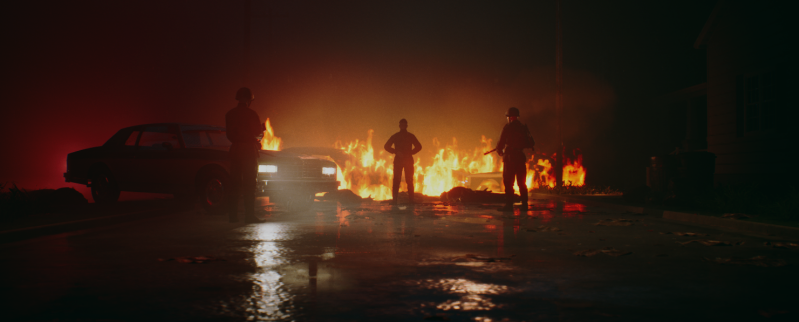
This combination creates a heavy, unsettling world where the warmth of the flames clashes with the surrounding coldness, emphasizing a sense of chaos and desolation.
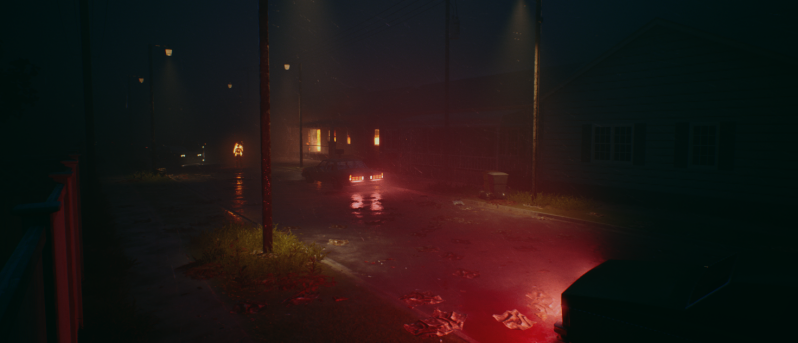
The environment relies on a contrast between cold tones and warm accents, particularly fire, to heighten tension and reinforce the dramatic mood.
